
“I find it really frustrating”: Why is it so hard to build affordable housing in Stroud?
Everyone needs a roof over their head. And while the housing crisis is a national issue, Stroud in particular is feeling the pinch. The local pressure for housing is in part driven by the town's rising popularity among ‘London leavers’ since the pandemic, and increasingly sought after by celebrities.
The Stroud District Council’s own housing strategy says that 365 new affordable homes are needed every year. While the council has acquired 276 new affordable homes since 2014, several thousand locals are still on the waiting list for social housing.
Yet concerns have been raised that some developers, squashed between the weight of planning bureaucracy and the steepening cost of construction, are using policy exemptions and planning revisions to build few affordable homes despite demand.
What is “affordable housing” anyway?
According to Homes England, ‘affordable housing’ can include rent schemes (at least 20% below market level), social rent schemes (50% of market rent), discounted home purchases or Shared Ownership for first-time buyers.
The Stroud District Local Plan requires new housing developments with four or more homes to include at least 30% affordable homes. But there are several loopholes that mean developers can avoid building them.
If planning applications are submitted for derelict brownfield sites, the council can accept far fewer affordable homes in return for restoring the disused land through a ‘Vacant Building Credit’ policy. There’s also a viability get-out clause, meaning developers can avoid building affordable homes if they can show it would be too expensive.
For example, the Copper Beach View development in Berkley by Ede Homes brought 39 new houses to the market earlier this year, but none were designated as affordable. That’s despite a previous planning application by Ede Homes on the same site, which included affordable homes, and was approved by the council in 2013 but never built. The developers can get away without building anything affordable because the brownfield land was previously the site of the Newport Towers Hotel, which was the victim of arson and anti-social behaviour after being left derelict in 2007.
When questioned about the lack of affordable homes at Copper Beech View, Ede Homes told Amplify Stroud:
“The previous Newport Towers Hotel, which was subsequently demolished, had a very similar footprint to our proposed scheme and therefore it removed the need for us to provide affordable housing. This was agreed and approved by the Council.”
‘Discharge of Conditions’ dodges affordable housing commitments
One barrier to building more affordable homes is that some approved planning applications for affordable homes wind up being sold or rented at costly market rates. Ambitious housing developments that don't propose to bring any affordable homes at all are often denied by the council, like at Sharpness Docks.
To get around this, a Stroud District Councillor has raised concerns that developers may be submitting planning applications that include affordable housing provisions in order to get planning approved, then later using ‘Discharge of Condition’ applications to remove affordability requirements once building begins. As explained by Councillor Lindsey Green, Conservative Group Leader on Stroud District Council and representative for Berkeley Vale:
"The problem that I have is that we quite often find that with big developments, there will be that 30% of social, affordable homes in there, and then we will get halfway through the development, and the developers come back to [the council], and they go for a ‘variation of conditions’, which then they say [they] can't afford to build the affordable homes. There's a mechanism in place for them to be able to come back and actually renege on that promise to begin with. I do find that really frustrating."
Daniels Industrial Estate
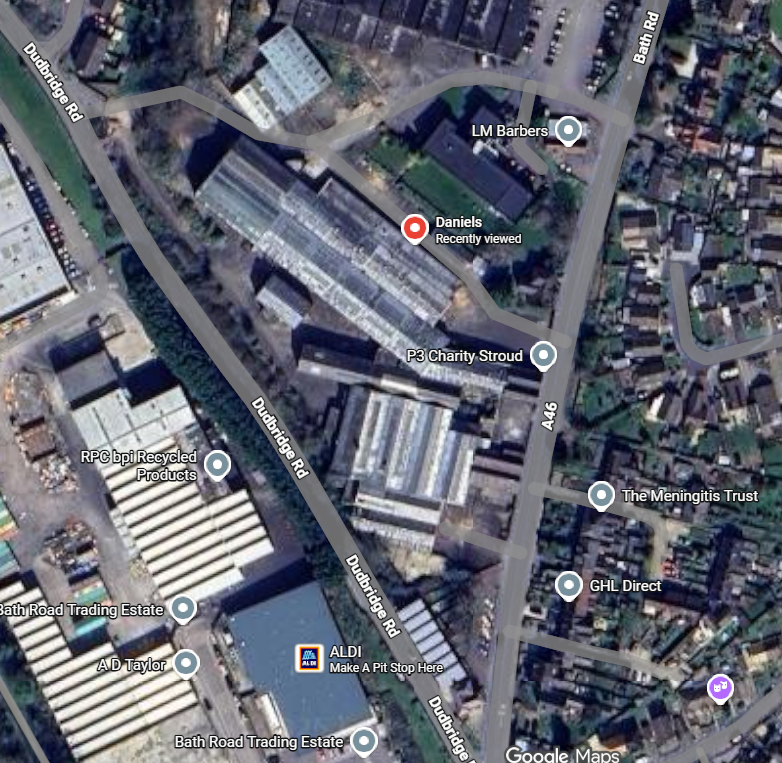
This appears to be what’s happened at the Daniels Industrial Estate, a large Stroud brownfield site being developed by Newland Homes. In 2023, the council greenlit plans for 111 low and zero-carbon homes. With the brownfield credit applied and financial viability factored in, the council and developers “compromised” on providing just three affordable homes.
This July, Newland Homes applied to have these affordable home requirements dismissed from the planning application, meaning none of the new homes will be affordable to low-income locals. In a letter to the council, Newland Homes argued that rising costs since 2020 meant that removing the affordable homes was “the only way to ensure this site comes forward.”
The letter also references a viability assessment submitted with the original planning application that showed that including any affordable homes would not be financially viable, but that this viability analysis “wasn't assessed as part of the application, instead [Newland Homes] and [Stroud District Council] agreed a compromise in our position.” It is not clear why this viability assessment was not included in the application, nor why a compromise on three homes was reached if the assessment already found this wouldn’t be financially viable.
Newland Homes’ Design Director Tom Sheppard said the developers have held “extensive discussions with the Council regarding this complex site, where we raised viability concerns we had about its delivery” before and during the planning process:
“We did present viability evidence to the planning officers, assessment of this by independent organisations is often a lengthy and protracted process. As the Vacant Building Credit was available, supported by [the] government to encourage development of brownfield sites, we chose at the time to accept a reduced viability position than we might otherwise have done, in order to secure planning permission and progress the site.”
The development sits within Rodborough Parish Council, which wrote to the District Council via their planning portal to object to the scrapping of the affordable homes, saying they were “extremely disappointed at the further reduction of affordable units on the scheme.”
When confronted with Councillor Green’s concerns regarding the use of Discharge of Condition applications to lower affordable housing requirements, Newland Homes said:
“We sympathise with the comments made by Councillor Green, it is unacceptable when planning permissions are revisited to cynically reduce or remove affordable homes. That certainly isn’t [the] case with the Daniels site.
“Since we purchased the site in 2023 costs have risen unexpectedly and at a rate well in excess of house price inflation, which has meant we have had to carefully re-evaluate the proposals. We believe the plans are designed as efficiently as possible, but given the significant demolition, remediation and retaining needed, the site is particularly complex. The viability pressures in this instance are unique and justified.”
Newland Homes added that they’re committed to building low and zero-carbon homes, and are a Gloucester-based business working with local partners and tradespeople. They declined to say whether they are currently building, or plan to build, any affordable homes in the Stroud District.
A Stroud District Council spokesperson said:
“While there is an assumption that development proposals are viable, the planning system recognises that site-specific circumstances can affect the deliverability of a scheme.
“Should an applicant wish the council to consider the viability of a proposal, then the council will require a full viability assessment to be submitted. Such assessments should follow the recommended approach in national planning practice guidance, including standardised inputs. The council will then engage an independent review of the appraisal. These are conducted by the District Valuers Services, part of the government’s Valuation Office Agency, on behalf of the council.
“Where schemes are demonstrated not to be viable, the council will work alongside the District Valuer to test various outputs to ensure that the maximum public gain from development is achieved.”
Building forward together
Whilst demand for affordable housing remains high, there are considerable barriers to delivering on these promises in practice. Planning applications take years to design, propose and approve, and are often subject to surprise problems once building begins.
The council’s new Local Plan for Housing was also rejected by inspectors in November, leaving them relying on outdated building plans in the District from 2015. It takes many years to put together a local plan, which, given that the council in its current form will be dissolved by 2027, creates yet another costly barrier to building much-needed affordable new homes for local people.
Stroud District Council also confirmed they’re currently working with developer Speller Metcalfe to build 44 new affordable homes across three sites in the district. Speller Metcalfe told Amplify Stroud that the homes would remain affordable and that two of the sites under development would be completed in Spring 2026.
About the Author
Alex Parnham-Cope is a local multi-media journalist and Assistant Editor at Amplify Stroud. He has written and produced content for Stroud Times, Good On Paper, Time Out, The Evening Standard, Journo Resources, Virgin Radio and more. You can keep up to date with his work on his website and follow him on instagram, @alex.pc.art




Member discussion